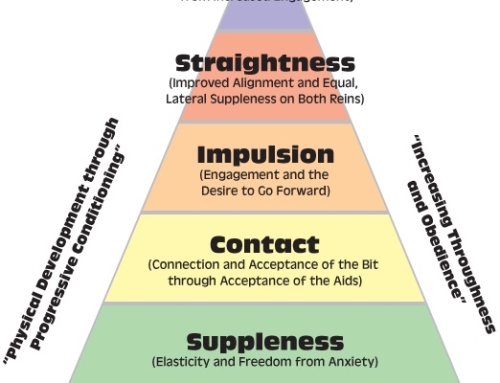


The classical riding community loves the term “lightness,” and the term is used often when talking about a horse that has been well trained or as part of the pursuit within training. Others scoff at the term as being a misnomer or even being deceptive, as horses “should have” contact when truly on the bit, and the pursuit of lightness is something foolish. But what actually is lightness? Is it minimal weight in the rider’s hand while maintaining a correct outline? Or is it something more?
Most riders I encounter believe lightness to be primarily within the hand. These riders pursue the picture ideal of looped reins during a piaffe (or even piaffe on the buckle), and they work tirelessly to achieve that feeling in the hand. However, to limit lightness to just the hand is ignoring the important part: the rest of the body.
As primates, we are a very hand-obsessed species. Most of what we do involves the hands: typing, cooking, using a phone, crafts, trades, etc. If we apply that to riding, however, we ignore the fact that most of the contact between us and the horse is through the body. Forgetting this is what gets us in trouble with lightness. Obsessing over the hand and trying to have a light feel with the horse maintaining outline can lead us into big problems, and this is why the skeptics of lightness (ahem, the stereotypical “German” school) tend to be a bit prickly about it.
If we over-obsess about the lightness in the hand, we can accidentally drop the back, disengage the haunches, and achieve the exact opposite of what we want. True collection is lost; the horse just slows down, drops the back, and gives a facsimile of the collected movements. The horse also becomes incredibly touchy about the bridle, either resisting the bit or ducking behind it instead of allowing it to be a communicator. They can also be paradoxically incredibly tough to ride, demanding a huge amount of leg and driving seat to get what you want.
What I’ve found works best is taking a holistic view to lightness. Karl Mikolka talked a great deal about the circle of the aids, but I like to rephrase it as the infinity symbol of energy: rider leg to horse leg, through the spine, over the poll, into the bit, through the rein, through the rider’s back, into the rider’s leg, and repeated. If you eliminate any one of those parts, something else has to pick up the slack. This is why horses trained to an artificially light hand can demand incredible strength to ride: your body has to replace the rein, and even then, the horse’s back struggles to take up its part when there’s nothing to “close the circuit.” Instead, why not train for lightness in that entire infinity symbol of energy?
Horses trained with that idea of lightness are so incredibly soft yet electric to the aids that sometimes it’s hard to know whether it was the horse or the rider who initiated the thought. Aids are so subtle that they’re delivered in grams, not even ounces, and even if the reins are looped, the energy is still flowing so that the horse stays in tune with the rider and balanced. The rider rides off the fascia, not the muscles, like how ballroom dancers communicate with each other through the softest changes in posture. They are in true self-carriage (which is a related but separate concept, in my opinion), and they respond eagerly to the lightest changes in the rider. These horses are also 1000% reliable for the job requested, whether that’s a demonstration of haute ecole (or a dressage test), a trail ride, or even working livestock in the doma vaquera or California vaquero traditions (or all of the above in working equitation!). You never feel that a truly light horse is going to explode at some point; they’re so attuned to their rider that the two just meld together, and anything else doesn’t really matter all that much. The trust is so shared that even if they do spook at something legitimate, the rider flows with them and moves on.
This is what lightness truly is, and getting there isn’t always so light and perfect in the beginning and in the journey. Sometimes, the horse simply doesn’t have the strength to be light at first. We still aim for it, but we have to look at the entire body for where it is in that particular moment of time. It could be that they’re weak in one hind leg, that their thoracic sling isn’t engaged, that the saddle doesn’t fit and is pinching the energy over the trapezius (not too uncommon!!!), or that they simply have practiced a different way of going so much that we have to retrain them in a new way of going. I talk a lot in biomechanics workshops about how muscle training is nerve training, and sometimes the pathways just aren’t there yet and have to be developed. Then, on top of that, learning is like the Fibonacci sequence: cumulative, but starting very small (a favorite quote of mine is “omnium rerum principia parva sunt,” “the beginnings of all things are small”). Lightness can’t always be achieved in a day, a month, a year.
However, we can build towards it. By looking at the whole horse and how they respond to our aids, we can help their mechanics be more efficient and gradually develop lightness (sometimes it comes on quickly! Sometimes it comes in waves until it’s solidified). Even more amazingly: there are hundreds of years of history and wisdom of Old Masters handed down through schools like the Spanish Riding School or the Court Riding School of Bueckeburg. The approaches are systematically laid out, breaking things down into logical chunks that don’t demand Herculean strength or even the most refined control from the rider (at first; it develops it with time). It doesn’t require an extremely “talented” rider; as Bob Ross said: “Talent is a pursued interest. Anything that you’re willing to practice, you can do.” Even riders with physical challenges can learn to ride with lightness, even if it looks a little different (like Ignaz Lauscha or Lisa Hartel).
The important thing is to be willing to put in the work and to listen to the whole horse, not just the hand. Are you willing to take the first step?
-Emily Wright
To learn more, sign up for riding or theory lessons at our location in Remsen, NY, at our trainer’s additional location at Bridlewood Dressage in Hillsdale, NY, or online through virtual lessons! More in-depth seminars also scheduled regularly and further courses and ebooks in progress. Contact us for more information!
Discover more from Tempus Renatus School of Classical Horsemanship
Subscribe to get the latest posts sent to your email.