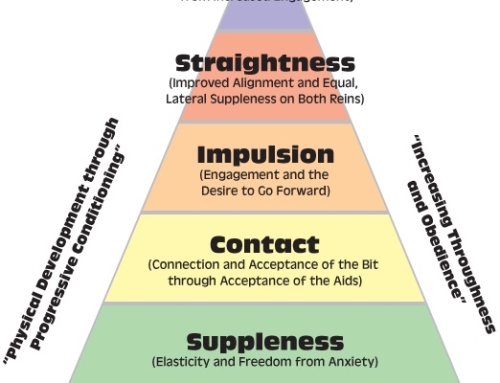



A challenge in learning classical riding is refinement. We watch videos and read about “invisible aids” and dream of being that good “one day.” We might sign up for a clinic with a classical rider, one famous for coming from somewhere amazing or studying under someone legendary, but once we get there, there’s frustration. The instructor doesn’t immediately go for that refinement we dream of. Even if they do, it sometimes feels awkward and bigger than we expected. Why is that?
Neurology of Learning
When we learn something, our brains and muscles have to develop new coordination. This is always awkward. Think about how babies start gripping things: they grab with full force and don’t easily let go. Same goes for when we’re first learning. The trainer may say “leg back,” and the leg either doesn’t want to move, or the calf moves without the thigh, or the whole thing moves awkwardly and dumps the pelvis forward.
This is normal.
If you don’t already have similar muscle pathways developed, it’s going to be awkward. The brain and muscles have to figure out refinement through practice and building themselves together. This is why in music, teachers encourage learning something by playing/singing LOUD. I remember learning Moonlight Sonata as youth by playing it loud until I got my timing, and then we dialed it back and added refinement. This is still how I learn a new piece if it doesn’t fit something I already know. This is completely normal and healthy!
So learning classical riding and aiming for those subtle aids… if we don’t already have similar muscle pathways, it’s going to be ungainly and awkward at first! It can throw off your seat if it is still finding a good “neutral” base to work from. Most classical trainers will already know this. They won’t teach you the most refined way at first because your neuromuscular system is just not ready.
This leads to a lot of frustration. “Why didn’t we start with this?” “But a year ago you told me to do it this way… why are we changing and refining it now?”
That is completely normal and valid to feel! However, it is important to remember that your instructor may not have given you the more refined way of doing things because you weren’t ready. Not because of any fault; your neuromuscular system just had some catching up to do. The instructor may not say why immediately; a lot of times, they’re thinking, “I know you want to do it the invisible way, but you’re not ready for that yet,” and since that can be misinterpreted and cause offense, they stay silent.
However, in time, your body should adapt to the point where you can start refining. Your timing gets more precise, you’re able to get back to neutral more easily, and you’ve developed better control of your body. Once you’re ready, then you get to learn the invisible aids.
The Horse’s Perspective
There’s also the issue of the horse’s perspective to this. Most horses have not been trained with invisible aids from the get-go. Most have been, in fact, desensitized to those aids inadvertently. If the balance or timing is a bit off, the horse will assume that those are mistakes in time and will stop responding to them. So, it may take some time to teach the horse to respond to the more subtle aids by stepping down what they’re used to just a little bit at a time. If you know the aids and have good timing, you can start teaching your horse immediately, but if you’re learning, the trainer may only take a small step towards invisible aids in the lesson to prevent frustrating both you and your horse. Over time, another step is taken toward more refinement, and then another. But you have to start at a point where your horse understands what’s being asked. If you start too subtle and escalate the intensity of your aids too quickly, the horse might be frustrated as well. A horse can feel a fly land on them, sure, but they can also ignore a lot if they’ve learned it doesn’t really mean anything.
What to do
So, when you go to some of your earliest experiences in learning classical riding, be kind to yourself and know that while you may dream of a certain level of refinement, there’s no rushing the learning process. Be open to a gradual process of learning refinement and know that at some point, you may have to re-learn something because it was a way to get you from where you were to where you need to be to get to where you want to be. “Rome wasn’t built in a day,” and neuromuscular learning also takes time to develop. Get comfortable with feeling awkward, make your mistakes loud, and trust the process.
-Emily Wright
Want to start your classical riding journey? Check out our lessons! You can come to us in Remsen, or we can come to you! Our instructor travels within the Mohawk Valley area near Utica and up to Lowville and Old Forge.
Discover more from Tempus Renatus School of Classical Horsemanship
Subscribe to get the latest posts sent to your email.