

So often when we think of a dressage rider, we think of a rider with a “perfect” seat and a horse that can just flow through the Grand Prix. This image, while beautiful, can be discouraging to others. “Oh, I can’t do that; I have scoliosis, so my seat will always be crooked.” “Oh, my horse can’t do that; he’s had an injury and can’t track up as well anymore.” It makes me so sad to hear these statements, because I know that is not the case. I have scoliosis and loose joints; there’s a lot I can’t do without pain (running, heavy weight-lifting, even many “normal daily” tasks), but riding is something I can do. One of my older warmbloods has cervical vertebral malformation, and while she may not be able to be a Grand Prix competitor, she offers Grand Prix feel in 3rd level movements. Another has scar tissue from his Amish days and has a somewhat uneven walk because of it, but once he’s loosened up, he has an amazing extended trot and beautiful pirouettes and piaffe.
Dressage, especially classical dressage, is meant for the horse and rider, not the other way around. It’s meant to help horses and riders who have challenges be the best they can be, even if it’s not “Grand Prix.” Almost any horse and rider can get to 3rd level, barring any major issues. It may not be perfect, but as long as it helps the horse and rider stay functional for longer, the dressage work has done its job. So what if you may not score as well at shows because of your struggles? That shouldn’t be the point of dressage anyway; shows can serve as a test of training, but they’re not the end goal.
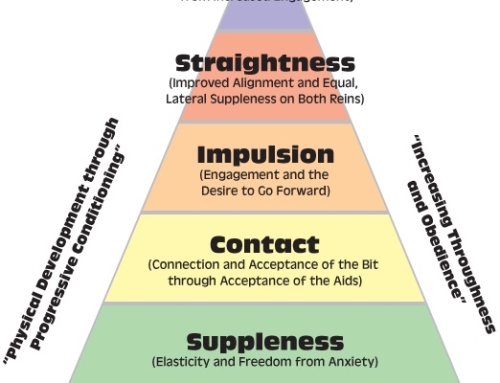
So how do we do dressage with bodies that may not serve us as well? We look at the point of the exercises and build from the foundation up. Let’s say we have a horse with a serious crookedness for whatever reason (maybe an injury and scar tissue). You can say that horse will never do shoulder-in evenly in both directions, OR you can say that shoulder-in will help to stretch the tight side and strengthen the weak side, but first, let’s start with circles and enlarging the circles to build up to that point. So what if the horse’s body will simply never let them be perfectly even in both directions? By improving its way of going, we’re preserving its health and soundness.
The same goes for riders. Some riders struggle with neurological weakness, often from injury, which is not the same as muscular weakness and is much more difficult to correct (and may never be “normal”). Let’s say we have a rider with a leg that isn’t as strong as the other. The beauty of classical riding is that strength doesn’t matter; it’s a matter of balance and position, and it can be quite subtle. So a rider with a neurologically weaker leg can still learn to ride half pass using more of their balance and position rather than pushing with the leg. We can adapt the seat and exercises by looking at the end goal and working a different path toward that end goal. For a rider who is crooked with scoliosis or limb differences, we can help that rider be “functionally” straight, even if it doesn’t look quite the same as a rider with a naturally straighter body. For example, my right shoulder blade does not lie flat, no matter how hard I try to make it, but where it’s stuck a little forward, I can compensate the balance by turning a little more with the rest of my seat. My right hip tends to drop and turn out, so I use my stirrup a little more to help push my hip up to get it out of the way. So while I’m not going to be as straight as I would if I had been blessed with a straighter spine, I can still functionally ride straight, even if it means having a few small compensations so that my horses still feel the aids the way they should. I also go back through seat exercises to help correct my seat as much as I can and prevent new problems from arising; this way, I don’t start spiraling into worse problems by over-compensating for things I can correct to a certain extent.
We may never make an imperfect body perfect, but we can frequently help an imperfect body exceed expectations by simply using the exercises to help it stay as healthy as it can. Karl Mikolka used to feel that the best definition of rehabilitative riding, “…is that kind of training you do, where you take a handicapped horse, so to speak, and you improve this animal to such an extent that at the end of his training, it looks like a super horse, worth a million. You build muscles where there are none, you strengthen the weak parts of your horse, you change his temperament, and you transform the whole body and the mind. In short, you make the horse into something which it wasn’t before. The entire training process has a healing effect on the animal, and this I consider the ultimate goal of horsemanship.” I feel the same can be done for the rider as well.
So while you or your horse may not have a perfect body, don’t let that keep you from trying dressage as a tool to help maximize what you and your horse can do. You will go far beyond your expectations and surprise yourself, and while the journey may not be easy, you’ll never regret taking that first step.
Discover more from Tempus Renatus School of Classical Horsemanship
Subscribe to get the latest posts sent to your email.