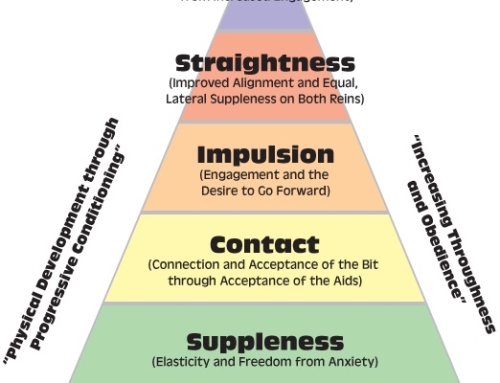


Last post’s topic focused on lightness, which is a feeling we get as well as a goal we aim for in our training. Most people equate this to self-carriage as well, but I like to think that lightness is the response to the rider while self-carriage is what the horse does to maintain its posture and biomechanics.
While self-carriage can result in improved lightness, making the two very closely related, they’re still slightly different. Like lightness, true self-carriage applies to more than just the head and neck. Lightness applies to all the rider’s aids, and self-carriage applies to the entire horse.
Self-Carriage in the Hand
This is the obvious form of self-carriage, but it is not the only one. In this aspect of self-carriage, the horse carries its own head and doesn’t rely on the rider to do the job for them. The feeling is light in the hand, and the poll is held proudly at the highest point (which can vary as the level of training progresses and even in different movements). It doesn’t necessarily mean that the reins are looped constantly, but it means that they could be. This aspect of self-carriage is really just a result of the rest of self-carriage being in place.
Self-propulsion
This is the first element that is required to develop full self-carriage. In self-propulsion, the horse maintains whatever tempo the rider sets. A large caveat to that, however, is that the rider must set the right tempo for the horse. Karl Mikolka called this “base tempo,” which is the tempo the horse can maintain over long distances without wavering. This is the ideal form of “working tempo,” but so often it is glossed over in training. This is a travesty; without establishing base tempo, the horse never really learns to become efficient and correct in its biomechanics, putting too much strain on its joints. It is simple enough to establish and maintain, but it requires dedication. The results are worth the work. The gaits become easier to ride, often smoother and more balanced, and it takes so much less effort to just ride.
From this base tempo, the horse can develop more collected paces and more extended paces (though none of these should be ridden for long stretches, as they require a lot of effort). Once it is established, the rider can request a gait or pace within the gait, and the horse should maintain it until a change is requested. This does mean that the horse must trust that the rider will not take advantage of them and push them unfairly (such as to maintain an extended trot for half a mile or more), and the rider must take care not to take advantage of the horse’s trust. However, isn’t trust one of the important elements of training anyway?
A horse who is not in self-propulsion will take a lot of effort to ride and maintain its gait or pace within the gait. In the early, utilitarian days of dressage, this would have resulted in a knight becoming too tired to fight effectively and therefore too easy to defeat in battle. They would have figured out quickly that a horse that is in self-propulsion is easier to ride and smoother, and they lasted longer in their careers.
Self-maintaining posture
Self-carriage also entails self-carriage of the whole body. This means that the horse continues to keep its back engaged and legs doing their appropriate job and their overall balance what it needs to be for the movement. For example, a regular “base tempo” trot should be easy for the horse to carry in natural carriage with its weight evenly working across all four legs, not heavy in the withers or leaning on one shoulder or too light in one hind leg. This takes a lot of stamina for the horse to develop, but it is important that they learn to balance themselves and maintain that balance without us having to hold them there.
Remember, of course, that it is never good to rigidly adhere to one posture or another, but the horse can learn different forms of self-carriage within the different postures. For example, they should be able to hold themselves through a canter pirouette without being held by the rider and then maintain appropriate balance at the end of the ride at the free walk, not completely fall apart in their bodies. If we as riders have to micro-manage the horse’s posture all the time, even if they feel light in the bridle, is the training we’re doing actually doing the horse any good?
Other important elements to self-carriage
Karl Mikolka once equated training for self-carriage to acupuncture. Unlike other forms of medicine, which add something to the system to shift chemical balances, acupuncture sets the body up to heal itself. Likewise, training should help the horse learn to carry itself and work itself more efficiently.
If the horse’s training doesn’t influence how the horse uses its body outside of the arena, what’s the point? We’re doing this to improve our horses and help them be the best they can be, and if we don’t set them up to figure out that moving in self-carriage with healthy mechanics feels better, we’re not doing them any favors. Self-carriage should apply outside the sandbox, not just riding on the trail but also how they move in the pasture.
This kind of self-carriage is entirely possible for horses of all breeds and backgrounds, and even ones that may have a few physical limitations. It is also not nearly as difficult as it sounds, but it does require dedication and consistency. The results, however, are worth every drop of sweat. Are you willing to take that step?
-Emily Wright
To learn more, sign up for riding or theory lessons at our location in Remsen, NY, at our trainer’s additional location at Bridlewood Dressage in Hillsdale, NY, or online through virtual lessons! More in-depth seminars also scheduled regularly and further courses and ebooks in progress. Contact us for more information!
Discover more from Tempus Renatus School of Classical Horsemanship
Subscribe to get the latest posts sent to your email.